Showing posts with label mattresses. Show all posts

Thursday, June 28, 2012

About Sleep & Mattresses


Sleep is when our bodies and minds rest, rebuild, and rejuvenate. The need is for deep, restful sleep; for most of us, 7-8 hours each day. 

The goal is spinal alignment and pressure relief for shoulders & hips.  To achieve this, the straw ticking of yester-year has been replaced by various densities and qualities of:
*  Traditional Poly Foam
*  Bio-Friendly (Soy Oils) Foam
*  Latex (natural rubber) Foam
*  Memory Foam

I can almost hear you smartphone lovers: When I say that mattresses are about technology, you roll your
eyes. The speed of a mattress does not double every 18 months, and mattress technology is not high tech! But it is technology that builds the machines, and it's science that improves the qualities of various densities, qualities, and firmness of foam.

Whatever the top of mattress is made of, the bottom of the mattress features one of 3 general types:
Tethered Springs
*  Pocketed Springs
*  High-Density Foam
Each type has its advantages.  Pocketed springs operate independently of one another, so for side-sleepers they're great for providing pressure relief for shoulders and hips.  Pocketed coils tend to flex to match body shape.  They also minimize motion transfer.  This means that when someone moves a sleep partner usually does not feel it enough to awaken. 
"Tethered" springs are bound together, and thereby coils flex and move with adjacent coils.  This means that most pressure relief for a side-sleeper's shoulder or hip must come from the foams on top of the springs.  Motion transfer is also greater - particularly on lower-end mattresses. 
High-Density Foam is used by Tempurpedic and its imitators.  In the mattress industry, this type of mattress is known as, "Specialty Sleep".  The specialty sleep category, by the way, is growing in double-digits, while traditional spring-based mattresses suffered a modest decline in year-over-year sales from 2010 to 2011. 
Note that springs are less expensive to produce than are foams, so mattresses that are made of foam, top-to-bottom tend to be premium priced.  At RC Willey I have a great selection in all three types.  Together we can figure out what is just right for you.

Keep Smilin'!

Monday, February 13, 2012

Are You Getting the Sleep You Need?


That is, are you getting the kind of sleep you need - and are you getting enough of it? In 1959 middle-aged Americans slept an average of 8-9 hours per night. By 1992 that number had reduced to 7-8; about an hour less. Between 1975 and 2006 the percentage of Americans getting less than 6 hours of nightly sleep increased from 24% to 30%.
DURATION
Sleep deprivation (restriction) reduces our performance during the day, and has adverse effects on our health. There are statistically significant correlations between those that are sleep deprived and those with hypertension, diabetes and weight gain.
QUALITY
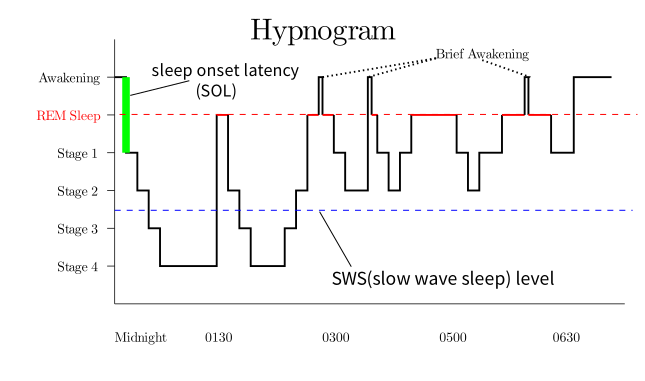
Scientists continue to study sleep and its patterns. Some theorize that there are 4; others that there are 5 levels of sleep. What matters most is that it is a deep stage of sleep in which our brain rejuvenates. Many of us experience persistent interruptions to our sleep before entering this deep stage. This leaves our brains tired and worn out. In such a foggy-headed state, our thinking abilities are suppressed. It's more difficult to think clearly, and to concentrate.
http://t2.gstatic.com/images?q=tbn:ANd9GcRtAOWE9Dz9JVWSi4bdn2fiJdga79GM1gVeO8KkGP9mKTUVc1e7CAUSES
One common cause of sleep interruption is apnea - a cutting off of air supply in the throat. Just as a sleep apnea sufferer is approaching a restorative deep sleep, there is a gasping for air. The sleep cycle is interrupted, and that deep level of sleep is not achieved. A moderate apnea sufferer may experience 20 to 30 or more such interruptions per hour. Many do not realize that such a problem exists, until a sleep partner notices it.
This can be diagnosed at a sleep center, and treated with a C-PAP machine (continuous positive air pressure). Such a treatment can keep the airways open, and allow for a deeper, more restful and restorative sleep.
The most common mattress problem is tossing and turning; this too can interrupt sleep. Pressure points cut off circulation, creating soreness, and sometimes a numbing sensation. Selecting the right mattress can correct this, as well as other problems, but that is the subject for another day.
In today's fast-paced and competitive world it is more important than ever to be at our best all day. If you wake up without feeling rested, if you are more tired than you think you should be, these are two areas of consideration.
Keep Smilin'! (or sleeping…)

Tuesday, February 7, 2012

Smiling Elevates Your Mood

Smiling involves the zygomatic muscles of the cheek and the eye. A full smile creates "crows feet" - the smile wrinkles around the eyes. Use of zygomatic muscles tells your brain to be happy. Perhaps that's why people who suffer from facial paralysis, and cannot smile, are more apt to be depressed.

My Professional Goal? Your Happiness. I want to put your zygomatic muscles to work!

That's why my professional motto is: KEEP SMILIN'

Choosing mattresses and furniture can be difficult for some; but there is no reason it can't be enjoyable. That's why I try to give each customer a reason to smile.

Smiling and laughing are good for your health. Some scientific findings:
1) Endorphins - These are brain chemicals that function as neuro-transmitters, and which make us feel happy. Laughing releases endorphins.
2) Health - A good laugh is beneficial to the lungs, boosts immunity, and burns calories.
3) Energy - Laughing increases energy and feeling of well-being.
4) Stress - Several things happen when a body is under stress:
a) heart rate accelerates
b) digestive system shuts down
c) blood sugar levels increase
Laughing reduces levels of cortisol, the stress hormone.

TIP
Next time you feel stressed, make a conscious effort to do two things:
1) Take Slow, Deep Breaths.
2) Create Crows Feed. Make a conscious effort with your eyes, using your zygomatic muscles.
QUIZ
#1) Does happiness help one smile? or does smiling help one be happy?
Answer: Both. People presented with cartoons who were already smiling found the cartoons more amusing.

Keep Smilin'!

Monday, January 30, 2012

Back Trouble? 5 Benefits of Zero Gravity

Do you - or someone you love - experience back pain? Maybe something NASA figured out long ago can help. Upon lift-off, an astronaut experiences terrific levels of G-Forces (multiples of the force of gravity). That's why they are on their back, with legs in an elevated position; like sitting in a chair tipped over on its back.
For those of us who are not strapped into a rocket, here are 5 terrific benefits of sitting or lying down the same way, for at least 10 minutes a day:


  1. Relieve Strained Back Muscles

  2. Reduce Stress

  3. Reduce Blood Pressure

  4. Reduce Heart Rate

  5. Improve Blood Circulation
Here at RC Willey, I have helped a lot of customers relieve back pain, by guiding them to the right type of mattress. For those who are looking for all 5 benefits above, I can help with that too, with a mattress equipped with an adjustable foundation, or with a zero-gravity chair. Either solution will get your body into proper position, and deliver.
Keep Smilin'!

Monday, January 23, 2012

Do You Toss and Turn?

The 1999 sleep study performed at the Sleep Disorder Center of Georgia found the following:

  • The average person tosses and turns 40 to 60 times every night.
  • 70% of the time you move, your partner moves within 30 seconds.
  • Partner tossing and turning reduces your deep sleep by 20%

    If reducing motion transfer from one side of the bed to the other is a priority for you, consider a memory foam mattress. These mattresses have no metal in them at all.
    The next best is a pocketed coil mattress. If you're going to have metal in your mattress, make sure the wire is not connected together, wire upon wire.
    The worst is the mattress in which metal springs are wired together. These mattresses transfer a lot of motion side to side.