Showing posts with label sleep apnea. Show all posts

Tuesday, April 30, 2013

ADHD in the Family? Check for Sleep Apnea

ADHD is correlated with a variety of sleep problems:
Daytime sleepiness - Is higher in children with ADHD
Sleep Disordered Breathing (eg Obstructive Apnea) - This is in as many as 50% of children with ADHD
Restless legs Syndrome - Also very common in children with ADHD

Sleep deprivation is a big problem in America. According to this study in the National Institutes of Health treating the sleep problems effectively can eliminate attention and hyperactivity issues in some children.

Keep Sleepin'!

Monday, June 18, 2012

Sleep Better - Live Better!

50 to 70 million Americans have chronic sleep disorders (National Institutes of Health).  The resultant drowsiness causes 100,000 traffic accidents (National Highway Traffic and Safety Adminstration), and takes 1,500 lives each year.  People who suffer from sleep apnea are also at greater risk for diabetes, hypertension, depression, stroke, and heart disease.  Chronic sleep problems increase the risk of each. 


What is apnea?  It is a common sleep disorder that is an interruption to breathing.  Apnea is usually caused by a collapse or obstruction in the airway, and can occur from once to as many as 100 times per hour.  Obstructive sleep apnea affects millions of Americans, and often goes undetected for years. 

Sleep apnea can be treated with a machine that creates continuous positive air pressure.  Pressurized and often humidified air is fed to the nose and/or mouth through a mask that is worn while sleeping.  This helps keep airways open, reducing the number of apneas per hour. 
As an alternative to a CPAP machine and mask, a mattress installed on an adjustable (electric power) foundation can elevate the sleeper's head enough to prevent collapses and blockages in the airway.  Even without sleep apnea, power foundations offer many benefits.  But the direct benefits to a sleeper with apnea are great.  A growing number of mattress types and models are being modified so they can flex with a power foundation. 

Keep Smilin'!
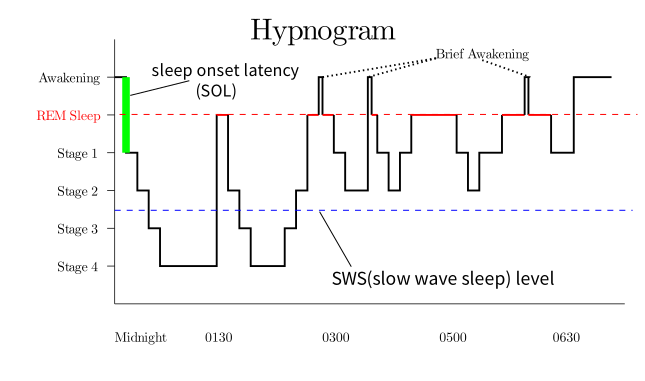
PS.  Here's a healthy sleep pattern, according to the latest research:

Monday, February 13, 2012

Are You Getting the Sleep You Need?


That is, are you getting the kind of sleep you need - and are you getting enough of it? In 1959 middle-aged Americans slept an average of 8-9 hours per night. By 1992 that number had reduced to 7-8; about an hour less. Between 1975 and 2006 the percentage of Americans getting less than 6 hours of nightly sleep increased from 24% to 30%.
DURATION
Sleep deprivation (restriction) reduces our performance during the day, and has adverse effects on our health. There are statistically significant correlations between those that are sleep deprived and those with hypertension, diabetes and weight gain.
QUALITY
Scientists continue to study sleep and its patterns. Some theorize that there are 4; others that there are 5 levels of sleep. What matters most is that it is a deep stage of sleep in which our brain rejuvenates. Many of us experience persistent interruptions to our sleep before entering this deep stage. This leaves our brains tired and worn out. In such a foggy-headed state, our thinking abilities are suppressed. It's more difficult to think clearly, and to concentrate.
http://t2.gstatic.com/images?q=tbn:ANd9GcRtAOWE9Dz9JVWSi4bdn2fiJdga79GM1gVeO8KkGP9mKTUVc1e7CAUSES
One common cause of sleep interruption is apnea - a cutting off of air supply in the throat. Just as a sleep apnea sufferer is approaching a restorative deep sleep, there is a gasping for air. The sleep cycle is interrupted, and that deep level of sleep is not achieved. A moderate apnea sufferer may experience 20 to 30 or more such interruptions per hour. Many do not realize that such a problem exists, until a sleep partner notices it.
This can be diagnosed at a sleep center, and treated with a C-PAP machine (continuous positive air pressure). Such a treatment can keep the airways open, and allow for a deeper, more restful and restorative sleep.
The most common mattress problem is tossing and turning; this too can interrupt sleep. Pressure points cut off circulation, creating soreness, and sometimes a numbing sensation. Selecting the right mattress can correct this, as well as other problems, but that is the subject for another day.
In today's fast-paced and competitive world it is more important than ever to be at our best all day. If you wake up without feeling rested, if you are more tired than you think you should be, these are two areas of consideration.
Keep Smilin'! (or sleeping…)